
I’m not a great one for ‘the perfect this’ or ‘the perfect that’ in recipes but if you’re a marmalade aficionado I promise you this is as good as it gets. Intensely fruity, thick and sharply flavoured.
OK, I’m biased. It was my mum’s recipe so it carries a bit of emotional baggage. I can remember the kitchen filling up with a warm, comforting marmaladey fug and sitting alongside her as a child slicing the oranges. She wasn’t a wonderful cook but this was her pièce de resistance. I still have the original written neatly in blue ink on a piece of Basildon Bond notepaper.
I’d got out of the habit of making it but she died just after Christmas so I wanted to make it in memory of those companionable times. Besides seville oranges are in season so now’s the moment.
First a few practicalities to keep down the cost because you can of course buy marmalade much, much more cheaply than it will cost you to make it. But it won’t taste anything like as good.
* Assuming you don’t have a preserving pan you need a large saucepan. A large stainless steel pasta pan is perfect. The bottom of a pressure cooker will do.
* You need jars. You can buy them from sites like Jam Jar Shop but that does add to the cost so beg or borrow some from neighbours. Not pickle or chutney jars in which the smell of the previous contents tends to linger. The jars need to be as clean as possible. Old recipes suggest sterilising them by putting them in a hot oven but I find a recent run through the dishwasher will do the trick.
* You need a muslin square or something to act as a muslin bag (I used a J Cloth). See why below. Oh, and some fine string
* You need waxed paper discs if you’re to keep the marmalade any length of time. And labels. Again from a specialist like Lakeland or the Jam Jar Shop.
* You need a couple of saucers in the fridge to test the set
* and finally, and most importantly, you need seville oranges, unwaxed lemons and sugar in the following quantities. The original recipe states preserving sugar but this is now so hard to get and twice as expensive as granulated so I would (and did) use that. No problem.
1.35 kg (3lb) Seville oranges, preferably organic
1 large or 2 small lemons, preferably unwaxed
1.7-1.8kg (3 3/4-4lb) granulated sugar
This makes about 7-8 400g jars but your jars will probably be all shapes and sizes and the quantity always turns out different depending how long you boil the marmalade so make sure you have slightly more than you need.
Wash and scrub the oranges and lemons with a vegetable brush and put them whole into a large pan with 1.3 litres (2 1/4 pints) of cold water.

Cover the pan with a lid or a large sheet of foil and bring slowly to the boil. Simmer for 1 1/2 to 2 hours, turning them occasionally until they are soft enough for you to pierce the skins with the end of a teaspoon. (You can probably remove the lemons after an hour and the oranges progressively after that). The kitchen will smell heavenly.

Remove the fruit and measure the remaining liquid. If there is less than 1.1 litres (just under 2 pints) add enough fresh water to bring it up to that level and return to the pan.
Cut the fruit into quarters, scoop out the pulp and separate out the pips. Cut the skins into small thick slices and add along with the pulp to the pan of water.


Tie up the pips in a piece of muslin (there’s a useful video here) and hang it over the handle of the pan and into the cut up fruit. This might seem a bit of a faff but the extra pulp and pectin helps the marmalade to set.
Put the sugar in a warming drawer or very low oven to warm up. Bring the fruit up to boiling point then remove the bag of pips and squeeze and scrape the outside of the bag to release any remaining pulp. Add the warm sugar to the fruit and leave over a low heat, stirring occasionally until dissolved.

Bring back to the boil and boil the marmalade for 25-30 minutes, stirring occasionally to prevent it sticking. Skim off the thick yellowish foam that forms round the edges from time to time.
Test a little on a chilled saucer after 25 minutes to see if it’s set. It should crinkle when you push it with your finger. If it doesn’t continue boiling it until it does. As the marmalade reaches setting point it will darken and grow thicker.

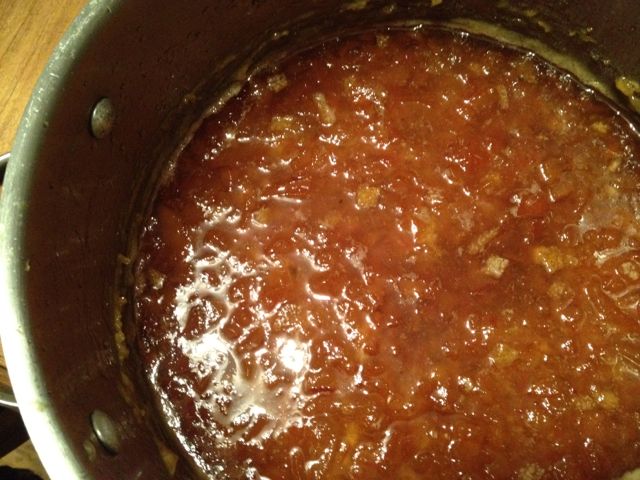
Once the marmalade has reached setting point, remove from the heat, skim off any remaining scum and allow to cool for about half an hour.
Warm your jars if they’re not already sitting in the dishwasher and ladle or pour the marmalade into them (I find a small jug is easiest for this). Cover with a disc of waxed paper, if using, and seal with screw top lids or clear covers. Wipe any splashes off the side of the jars while they’re still warm.
Leave until cold before labelling otherwise the labels won’t stick.

Feel smug and happy.
You can of course cut the amount of work involved by mincing the peel but I like proper looking chunks in my marmalade. Just get someone to sit alongside you as you do it. It’s a nice thing to do with your kids, a mum, gran or sister or a friend. Actually my husband helped me with this batch while we listened to Bob Marley. Good marmalade music.
Oh, and a final tip. You can freeze seville oranges successfully if you haven’t time to make all your marmalade in one go or run out of jars. Just wash and dry them before you freeze them, use them from frozen and increase the boiling time until they’re cooked through.
Is this how you make your marmalade or do you reckon you have a better version?


