Monday, 20 February 2012

Braised chicory with Roquefort

0 comments

Having spent the last 10 days in France it's struck me again what a mystery it is that you can't order more vegetable-based dishes in French restaurants. It's not that they don't have the produce. Down in the Languedoc they have gorgeous leeks right now and great bagfuls of chicory which is something you rarely find in the UK - or not at a reasonable price. Yet the only greenery most restaurants seem to offer - and have done for the past umpteen years - is salade de chèvre chaud (grilled goats' cheese salad).

Anyway I took advantage of some very good prices (about €2.50 a kilo) to buy 5 heads of chicory to make a side dish to go with yesterday's roast chicken. This is roughly the recipe.

Braised chicory with Roquefort
Serves 4-6
5-6 heads of chicory
1 tbsp lemon juice
2 tbsp olive oil
20g butter
About 125ml chicken or vegetable stock
50g Roquefort or other blue cheese. Or almost any leftover cheese for that matter - Comté would be good.

Cut the heads of chicory in half lengthwise and remove any damaged outer leaves. Fill a large shallow pan with water, bring to the boil and add the lemon juice to stop the chicory discolouring. Add the chicory, reduce to a simmer and cook for 4-5 minutes then remove with a slotted spoon.

Discard the water from the pan, add the oil and then the butter. Once melted lay the halved chicory heads in the pan and fry until well browned, turning them carefully halfway through so as not to break them up. Lay them cut side upwards in a shallow baking dish, pour over the stock and crumble over the cheese. Cook alongside whatever roast you're cooking for another 10-15 minutes until the cheese is lightly browned and the stock pretty well evaporated.

I also made a dish of leeks vinaigrette for which I posted a recipe on the blog a couple of years ago. Good to be reminded how good it is though and leeks are very tasty at the moment.

Read more ►

Sunday, 5 February 2012

Dukka (or Dukkah)

0 comments

If you're someone who never manages to use up the nuts or spices you buy for a recipe dukka (aka dukkah) could be your salvation. Basically it's a ground up mixture of roasted nuts, spices and dried herbs in which to dunk bread or raw vegetables. It appears to originate from Egypt though has become very fashionable in Australia. And it's dead tasty.

To keep down the cost if you're making it from scratch buy one of those packs of mixed chopped nuts. I'm not mad about their flavour normally but if you roast them and mix them with spices they taste fine - just nicely nutty. And - hopefully it doesn't need saying by now - buy your spices from a ethnic grocer rather than from the supermarket. You'll pay a fraction of the price.

Makes about 250g mix - enough to feed a group of six to eight though obviously check no-one has a nut allergy.

100g chopped mixed nuts
75g sesame seeds
25g coriander seeds
10-12g cumin seeds
1 level tsp dried oregano
1 level tsp sea salt
1/2 tsp black peppercorns

Preheat the oven to 180°C/350°F/Gas 4

Spread the nuts and seeds on separate baking trays or tins and roast them in the oven until lightly coloured and fragrant - about 7-8 minutes for the nuts, 4-5 minutes for the coriander and seeds and 3-4 minutes for the sesame seeds. (It might sound a faff roasting them separately but you don't want to overcook them. You could toast the cumin seeds in a dry frying pan if you like. The main thing is to watch them like a hawk).

Set the nuts and spices aside to cool. Put the nuts and peppercorns into a food processor or spice grinder, pulse a few times then add the coriander, cumin and sesame seeds and oregano and salt and pulse again. Don't overdo it - you want a rough textured mixture that looks like coarse breadcrumbs (see below). If you haven't got a food processor you could use a pestle and mortar to grind everything up but that's obviously harder work.

Serve with good olive oil, chunks of bread or warm pitta bread and raw veg like carrots and radishes. It's also great as a sprinkle over roast vegetables or you can use it as a coating for soft goats' cheeses - or a topping for roast fish. You could add a few chilli flakes if you want to spice it up but this version is better for kids (provided, just to stress it again, they're not allergic to nuts).

You can keep any leftover dukka for a week or two in an airtight tin or plastic box though you might want to refresh it in the oven for 2-3 minutes before you serve it.


By the way the beetroot dip in the rather messy pic above (suddenly remembered I should snap it half way through eating it) is made from a couple of vac-packed beets - a recipe I adapted from Stephen Markwick's A Well-Run Kitchen. You simply chop them up and whizz them with 2 tbsp Greek yoghurt, 1 tbsp balsamic vinegar, about a teaspoon of ground roast cumin, a pinch of hot pimenton or cayenne pepper and 3 tbsp olive oil and season well with salt and pepper.
Read more ►

Sunday, 29 January 2012

The Great Fresh Herb Rip-Off

0 comments

I've banged on about this before and probably will again but I just wanted to have another moan about the extortionate price of fresh herbs in supermarkets. Witness this 25g bag of flat leaf parsley that was on sale at Waitrose yesterday for 89p. That's £35.60 a kilo, more than the cost of fillet steak.

I can buy a bunch roughly 10 times that size from my local greengrocer for just over £1 and so, I'm sure, can you. It's really time supermarkets stopped ripping us off.

That said I did find quite a useful product in the frozen cabinets as part of Waitrose's Cooks Ingredients series which was a pack of Thai mix - a mixture of lemongrass, coriander, ginger, chilli and garlic - which would be quite handy to keep in the freezer. It won't pack quite the punch of fresh ingredients but is probably more economical than buying them individually, certainly for a single dish. Normally £1.49 a pack at the moment they're on offer at 2 for £2.50. You can also buy frozen coriander that way.

Do these pesky packets of fresh herbs annoy you too or is it just me?
Read more ►

Saturday, 21 January 2012

A weekend to buy whisky

0 comments
With Burns Night coming up this week and many celebrating it this weekend, now's a good time to stock up on your favourite whisky brand. Almost all the supermarkets have got special offers. Here's my pick of the bunch (meaning the best deals, not necessarily the best whiskies - see comments!)

Asda
1 litre bottles of Famous Grouse for £16 instead of £18.97 - standard bottles for £13.47 (£16.50-17 elsewhere)
Glenmorangie 10 y.o. for £21.97 (£33-£34 elsewhere)
Isle of Jura 10 y.o. for £19 (£28-29 elsewhere)

Morrisons
Grants £12.99 instead of £14.99

Sainsbury's
Halves of Famous Grouse for £7.29 instead of £8.29
Whyte & Mackay £12 instead of £15.79
Talisker at £25 instead of £31.99
Glenlivet French Oak reserve at £25 instead of £34.79

Tesco
Aberlour 10 y.o. for £21 (£25-27 elsewhere)

Waitrose
Ardbeg £34.50 instead of £40.50
Knockando £24.75 instead of £30.75

Booths also seem to have some good whisky offers with £10 off a number of leading malts including Ancnoc 12.y.o. and Old Pulteney 12 y.o., though they unhelpfully don't say what the discounted price is on their site. Apart from Isle of Jura 12 y.o. which is down to £20.95 from £30.95.

And Lidl has a decent own brand whisky called Hunter's Glen (yes, naff I know but it's fine) for £11.99.
Read more ►

Sunday, 15 January 2012

How to make the best marmalade you’ve ever tasted

0 comments

I’m not a great one for ‘the perfect this’ or ‘the perfect that’ in recipes but if you’re a marmalade aficionado I promise you this is as good as it gets. Intensely fruity, thick and sharply flavoured.

OK, I’m biased. It was my mum’s recipe so it carries a bit of emotional baggage. I can remember the kitchen filling up with a warm, comforting marmaladey fug and sitting alongside her as a child slicing the oranges. She wasn’t a wonderful cook but this was her pièce de resistance. I still have the original written neatly in blue ink on a piece of Basildon Bond notepaper.

I’d got out of the habit of making it but she died just after Christmas so I wanted to make it in memory of those companionable times. Besides seville oranges are in season so now’s the moment.

First a few practicalities to keep down the cost because you can of course buy marmalade much, much more cheaply than it will cost you to make it. But it won’t taste anything like as good.

* Assuming you don’t have a preserving pan you need a large saucepan. A large stainless steel pasta pan is perfect. The bottom of a pressure cooker will do.

* You need jars. You can buy them from sites like Jam Jar Shop but that does add to the cost so beg or borrow some from neighbours. Not pickle or chutney jars in which the smell of the previous contents tends to linger. The jars need to be as clean as possible. Old recipes suggest sterilising them by putting them in a hot oven but I find a recent run through the dishwasher will do the trick.

* You need a muslin square or something to act as a muslin bag (I used a J Cloth). See why below. Oh, and some fine string

* You need waxed paper discs if you’re to keep the marmalade any length of time. And labels. Again from a specialist like Lakeland or the Jam Jar Shop.

* You need a couple of saucers in the fridge to test the set

* and finally, and most importantly, you need seville oranges, unwaxed lemons and sugar in the following quantities. The original recipe states preserving sugar but this is now so hard to get and twice as expensive as granulated so I would (and did) use that. No problem.

1.35 kg (3lb) Seville oranges, preferably organic
1 large or 2 small lemons, preferably unwaxed
1.7-1.8kg (3 3/4-4lb) granulated sugar

This makes about 7-8 400g jars but your jars will probably be all shapes and sizes and the quantity always turns out different depending how long you boil the marmalade so make sure you have slightly more than you need.

Wash and scrub the oranges and lemons with a vegetable brush and put them whole into a large pan with 1.3 litres (2 1/4 pints) of cold water.


Cover the pan with a lid or a large sheet of foil and bring slowly to the boil. Simmer for 1 1/2 to 2 hours, turning them occasionally until they are soft enough for you to pierce the skins with the end of a teaspoon. (You can probably remove the lemons after an hour and the oranges progressively after that). The kitchen will smell heavenly.


Remove the fruit and measure the remaining liquid. If there is less than 1.1 litres (just under 2 pints) add enough fresh water to bring it up to that level and return to the pan.

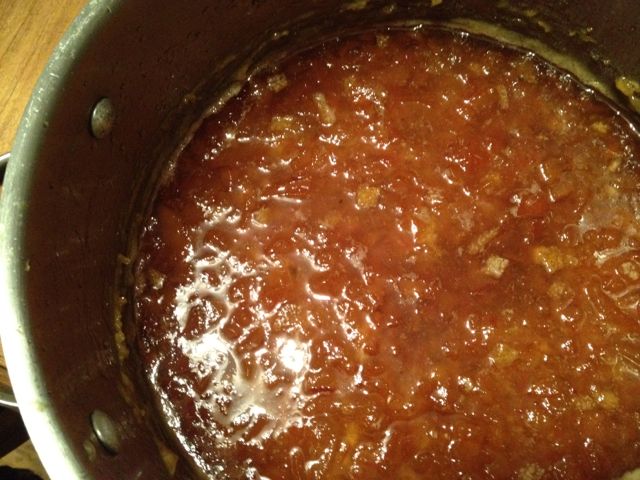
Cut the fruit into quarters, scoop out the pulp and separate out the pips. Cut the skins into small thick slices and add along with the pulp to the pan of water.


Tie up the pips in a piece of muslin (there’s a useful video here) and hang it over the handle of the pan and into the cut up fruit. This might seem a bit of a faff but the extra pulp and pectin helps the marmalade to set.

Put the sugar in a warming drawer or very low oven to warm up. Bring the fruit up to boiling point then remove the bag of pips and squeeze and scrape the outside of the bag to release any remaining pulp. Add the warm sugar to the fruit and leave over a low heat, stirring occasionally until dissolved.


Bring back to the boil and boil the marmalade for 25-30 minutes, stirring occasionally to prevent it sticking. Skim off the thick yellowish foam that forms round the edges from time to time.

Test a little on a chilled saucer after 25 minutes to see if it’s set. It should crinkle when you push it with your finger. If it doesn’t continue boiling it until it does. As the marmalade reaches setting point it will darken and grow thicker.


Once the marmalade has reached setting point, remove from the heat, skim off any remaining scum and allow to cool for about half an hour.

Warm your jars if they’re not already sitting in the dishwasher and ladle or pour the marmalade into them (I find a small jug is easiest for this). Cover with a disc of waxed paper, if using, and seal with screw top lids or clear covers. Wipe any splashes off the side of the jars while they’re still warm.

Leave until cold before labelling otherwise the labels won’t stick.


Feel smug and happy.

You can of course cut the amount of work involved by mincing the peel but I like proper looking chunks in my marmalade. Just get someone to sit alongside you as you do it. It’s a nice thing to do with your kids, a mum, gran or sister or a friend. Actually my husband helped me with this batch while we listened to Bob Marley. Good marmalade music.

Oh, and a final tip. You can freeze seville oranges successfully if you haven’t time to make all your marmalade in one go or run out of jars. Just wash and dry them before you freeze them, use them from frozen and increase the boiling time until they’re cooked through.

Is this how you make your marmalade or do you reckon you have a better version?
Read more ►

Friday, 13 January 2012

Waitrose Low Alcohol Cider

0 comments
If you're finding it hard to give up booze for the month you might want to snap up a bottle or two of Waitrose's low alcohol cider which is only 1% ABV.

Now I'm not saying it's the best-tasting cider ever - it's a little too thin and too sweet, for my palate at least* - but it does taste recognisably like cider in a way that apple juice doesn't and if you were drinking it with roast pork, a chicken casserole or even a nice hunk of cheddar it would rub along fine. It's actually made in Herefordshire in old oak vats so I'm guessing it probably comes from Weston's.

The price is pretty attractive too. It only costs £1.15 a 500ml bottle - online at any rate. I somehow ended up paying £1.21 for my bottle in store, maybe because it's classified as a 'Little Waitrose'. Not a huge outlay anyway.

* However my neighbour who just popped in tried it and said 'really nice'. So there you go. I should also have pointed it's 180 calories a glass so it's not exactly a low calorie option - though not much more than a large glass of shiraz.
Read more ►

Tuesday, 10 January 2012

Change of domain name for Beyond Baked Beans

0 comments
Following yesterday's post the good news is that my student cookery site Beyond Baked Beans is back up and running but at a new domain name www.beyondbakedbeans.org.

If you link to the site please change your link. And if you don't, do link to it which will help students - and other first time cooks on a budget - find it more easily.
Read more ►
 

Copyright © Frugal Cook News Design by O Pregador | Blogger Theme by Blogger Template de luxo | Powered by Blogger